

Why Real Runes Matter in Modern Norse-Inspired Apparel
Norse-inspired clothing is everywhere, but not every symbol printed on a shirt, hoodie, or pair of leggings is actually a rune. Modern fantasy art often borrows the sharp angles and carved appearance of historical runic writing, then combines those shapes into symbols that may look convincing without belonging to any real runic alphabet.
There is nothing inherently wrong with fantasy artwork when it is presented as fantasy. The problem begins when invented symbols are described as ancient runes or assigned historical meanings they never had.
For Black Rune Works, using real runes whenever a design is intended to be rune-focused creates a stronger foundation. The artwork can still be modern, metallic, bold, colorful, or surrounded by knotwork, but the central symbol begins with something that actually belongs to a documented runic tradition.
That distinction matters because a rune is more interesting when the person wearing it can learn where it came from, how it was used, and how later generations have interpreted it.
Modern clothing does not need to imitate Viking Age clothing to respect the symbols that inspire it. A T-shirt, hoodie, jogger, or pair of leggings can be completely contemporary while carrying a rune whose form reaches back centuries.
That combination of old visual language and modern clothing is where rune-inspired apparel becomes more than generic graphic merchandise.
Runes Were a Writing System Before They Became Modern Symbols
Runes were not originally created as a collection of mystical logos.
They were letters.
Different Germanic peoples used several runic alphabets over long periods of time. The Elder Futhark is among the best known today and contains twenty-four characters. Later systems, including the Younger Futhark, developed as language changed.
This historical background is important because modern popular culture often treats every rune as though it came with one fixed spiritual definition.
Reality is more complicated.
Rune names, linguistic roots, inscriptions, historical use, later poetry, archaeological evidence, and modern interpretation all contribute to how people understand individual symbols today. Some modern meanings have stronger historical support than others.
That does not make contemporary interpretation meaningless.
It simply means there should be a difference between saying, “This rune historically existed,” and saying, “This is one way people interpret it today.”
Keeping those ideas separate creates more honest and interesting designs.
Why Invented Rune-Like Symbols Can Be Misleading
A symbol can look ancient without being ancient.
Sharp lines, symmetrical branches, angular geometry, and carved textures immediately suggest something runic to modern viewers. That visual language is so recognizable that designers can create entirely new symbols that still feel convincingly Norse.
The problem is not the artwork itself.
The problem is labeling it incorrectly.
If a completely invented symbol is marketed as an ancient rune of eternal love, destiny, protection, or wealth, the design gains credibility from a history it does not actually possess.
Black Rune Works can take a different approach.
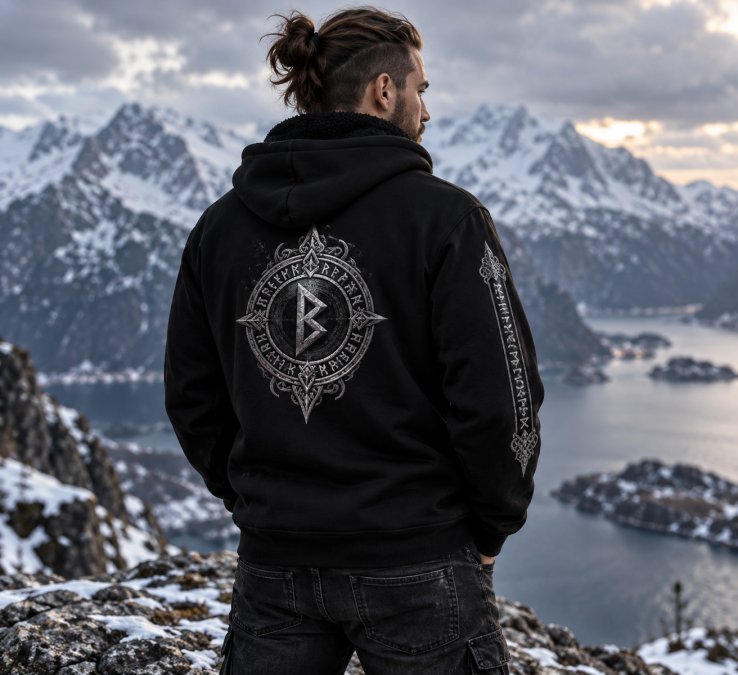
When a design uses a real rune, the rune can remain recognizable even when surrounded by modern artwork. Knotwork can frame it. Metallic textures can give it depth. Additional Nordic-inspired elements can support the design.
The central symbol does not need to be fabricated simply to make the piece visually interesting.
Real runes already provide more than enough material to work with.
Historical Form and Modern Meaning Can Coexist
Using a real rune does not mean every design has to look archaeological.
That would defeat the purpose of modern apparel.
A rune can keep its historical form while the surrounding design becomes completely contemporary. Silver, bronze, chrome, gold, teal, or other visual treatments can change the mood without changing the underlying symbol.
A clean rune placed inside wide knotwork can feel ornamental. The same rune rendered in weathered bronze can feel heavier and more rugged. A silver version against black can feel colder and more restrained.
The shape remains recognizable.
The presentation changes.
That is where design becomes creative without needing to invent history.
The artwork does not have to pretend that a modern shirt existed centuries ago. It can acknowledge that the garment is modern while allowing the rune itself to provide the historical connection.
Meaning Becomes Stronger When You Understand the Symbol
A person does not need to become a runologist before wearing a rune design.
A little understanding still makes the symbol more interesting.
Someone may first notice a rune because of its shape. They may then learn its name, where it belongs within a runic alphabet, how the name has been translated, and which modern interpretations have developed around it.
That process creates a relationship with the symbol.
The person is no longer wearing a random angular graphic.
They know what they chose.
That does not mean everyone will interpret the same rune identically. Historical evidence is often limited, and modern symbolic associations have developed over many centuries.
Personal meaning can exist alongside that uncertainty.
Someone can understand that a particular modern interpretation is not an archaeological fact while still choosing the rune because the idea resonates with them.
That is a far stronger foundation than pretending every modern claim is ancient history.
Rune Design Should Start With Clarity
A rune-focused garment works best when the rune is easy to recognize.
It can be tempting to surround the central symbol with so much ornament that it becomes almost impossible to see. Dense knotwork, multiple borders, additional runes, animals, geometric patterns, and metallic textures can all compete for attention.
Strong design usually does the opposite.
It creates hierarchy.
The eye should understand what matters first.
If the rune is the central idea, it should remain visible from a normal viewing distance. Supporting elements should lead the eye toward it rather than burying it.
Negative space becomes extremely valuable here.
Empty black space around a metallic rune can make the symbol feel larger without increasing its physical size. Wide knotwork can create a strong frame without touching every edge of the design.
Restraint allows detail to remain readable.
Wide Knotwork Supports Rune Artwork Better
Knotwork is one of the most useful supporting elements in modern Norse-inspired apparel, but it needs room.
Very narrow or overly complicated knotwork may look impressive when enlarged on a computer screen. Once printed on a shirt or sleeve, the strands can blend together and lose their structure.
Wider knotwork usually performs better on apparel.
The crossings remain visible. The viewer can follow the path of the design. It continues to look intentional when the fabric folds or moves.
This is especially important on sleeves and pant legs, where the available design area is long but relatively narrow.
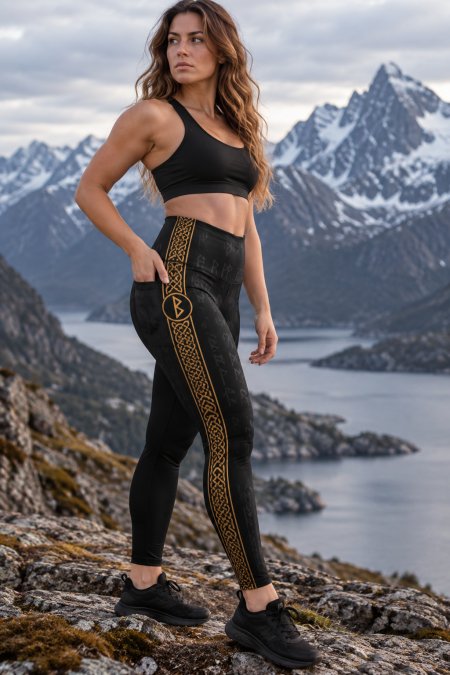
A clean vertical knotwork band can complement a central rune without competing with it. The design gets texture and movement while remaining easy to read.
That balance fits the Black Rune Works visual direction particularly well.
Complexity can come from structure instead of clutter.
One Rune Can Be Stronger Than Twenty
Covering a garment in runes can create an immediate Nordic appearance, but it does not automatically make the piece more meaningful.
Sometimes one rune is enough.
A single central symbol becomes easier to recognize, easier to explain, and easier for the wearer to develop a personal connection with.
Multiple runes can still work when there is a reason for them to be there. A controlled background pattern can create texture. A vertical sequence can become part of a sleeve treatment. A border can support the central artwork.
What matters is intention.
Random symbols used only to fill empty space usually weaken the design.
A strong garment should be able to answer a simple question: why is this symbol here?
If there is no answer beyond “the space looked empty,” the design probably did not need it.
Apparel Changes How a Rune Should Be Designed
The same rune should not necessarily be presented identically on every product.
A T-shirt provides a large flat area across the front and back. A hoodie introduces sleeves, pockets, a zipper, and sometimes a hood. Leggings have narrow vertical panels and need to accommodate stretch and movement. Shorts create smaller areas with different seams.
The artwork should adapt.
A rune that works as a large central back graphic might become a smaller emblem on a shirt. The surrounding knotwork might move down a hoodie sleeve. A legging design may need to follow the outer leg rather than sit directly in the center.
The symbol remains recognizable, but the composition changes.
This is what makes a design feel like it belongs on the garment instead of being pasted onto it.
The product itself becomes part of the artwork.
Metallic Effects Give Runes Different Personalities
Color does more than decorate a rune.
It changes how the design feels.
Gold artwork against black creates strong warmth and contrast. It can make knotwork feel ornamental and give a central rune an almost forged appearance.
Silver creates a cooler mood. It can feel more restrained, sharper, and more modern.
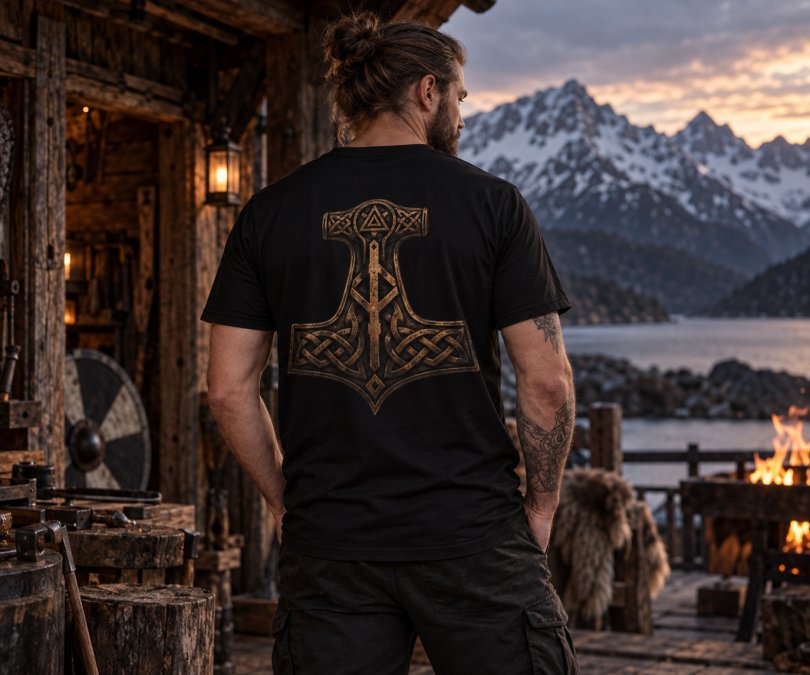
Bronze brings a weathered quality that works especially well with Mjölnir, runes, and heavy knotwork. It suggests aged metal without requiring the garment to imitate historical clothing.
Brighter accents can take the artwork in another direction entirely.
Teal, cyan, and other modern color combinations can preserve Nordic structure while making the finished piece feel contemporary.
There is no rule that Norse-inspired artwork must always look old.
The symbol provides the historical connection.
The designer decides how it enters modern life.
Runes Do Not Need Mystical Claims to Be Meaningful
A rune can matter without claiming supernatural power.
That distinction is important.
Someone may wear a rune because it reminds them of resilience, protection, growth, discipline, or another personal principle. The garment can become a visual reminder without requiring the wearer to believe that the printed symbol itself changes external events.
This makes rune-inspired clothing accessible to people with very different beliefs.
One person may connect with the rune historically. Another may appreciate the design artistically. Someone else may attach a deeply personal meaning to it.
All three relationships can exist.
The symbol does not need exaggerated claims to become significant.
Meaning can come from understanding, repetition, memory, and personal association.
The Wearer Eventually Adds Their Own Story
The designer begins the process, but the wearer finishes it.
A rune shirt may start as a piece of artwork chosen because someone likes the symbolism. After months or years of wear, the garment accumulates memories.
It may be the hoodie they wore through a difficult winter. The shirt they kept reaching for during a major project. The piece they packed for a meaningful trip.
Eventually the garment means more than the original product description.
That is one reason symbolic clothing can become personal in a way ordinary graphics sometimes do not.
The symbol gives the garment a starting point.
Life gives it context.
Modern Norse Apparel Does Not Need to Pretend to Be Historical Clothing
Respecting historical symbolism does not require historical reproduction.
Black Rune Works is not attempting to recreate Viking Age wardrobes.
The clothing is modern because the people wearing it live now.
T-shirts, full-zip hoodies, sherpa-lined garments, leggings, joggers, shorts, and other contemporary pieces can carry runic artwork without pretending to be archaeological replicas.
That distinction allows the symbolism to remain relevant.
Someone can wear a rune design to work, during travel, while training, outdoors, or during an ordinary weekend.
The symbol becomes part of contemporary life.
That is more useful than restricting Norse-inspired imagery to festivals, reenactment, or costume clothing.
Good Rune Design Respects Both History and Creativity
Historical respect does not mean creativity has to stop.
It gives creativity a stronger foundation.
A designer can start with an actual rune, understand what can and cannot reasonably be claimed about it, then build something new around it.
The knotwork can be original.
The composition can be modern.
The metallic treatment can be new.
The garment can be something that would have been completely unfamiliar to the people who once used runes as writing.
None of that erases the connection.
The important part is knowing which pieces come from history and which pieces come from the modern designer.
That honesty makes the design stronger rather than weaker.
Why This Matters for Black Rune Works
Black Rune Works is increasingly centered around runes, Nordic pattern, knotwork, and modern apparel rather than costume-like interpretations of Norse culture.
That makes accuracy more important.
If runes become a major part of the visual identity, they should be treated with enough respect that the artwork does not depend on fictional symbols presented as historical ones.
At the same time, the brand should not become trapped by historical reproduction.
Modern metallic finishes, strong color, wide knotwork, bold back graphics, sleeve designs, athletic apparel, and new product types can all continue evolving.
The rune provides the foundation.
The artwork builds outward from there.
That creates a design language that can grow across shirts, hoodies, leggings, shorts, joggers, and future products without losing its identity.
A Rune Should Mean More Than “This Looks Viking”
That may be the simplest standard.
Norse-inspired apparel becomes more interesting when the symbol has a reason to exist.
A rune should not be there only because it makes the garment look Nordic.
Choose the rune because the form is real. Understand its historical foundation as far as the evidence allows. Be clear when an interpretation is modern. Design around it without destroying the symbol. Give it enough space to remain readable.
Then let the wearer decide what it eventually means to them.
That combination of history, design, and personal interpretation gives modern rune apparel something generic fantasy graphics cannot easily reproduce.
It gives the symbol continuity.
The rune existed before the garment.
The garment carries it into the present.
The wearer decides where it goes next.
Frequently Asked Questions
Are all symbols that look like runes actually historical runes?
No. Modern fantasy and Nordic-inspired artwork frequently includes invented symbols that resemble runic writing. A symbol can have a runic visual style without belonging to a documented historical rune row.
What is the Elder Futhark?
The Elder Futhark is an early Germanic runic alphabet containing twenty-four characters. It predates the Viking Age and is one of several historical runic systems.
Can a historical rune have a modern personal meaning?
Yes. Historical context and personal interpretation are separate things. Someone can understand where a rune comes from while also developing a personal association with it.
Does Black Rune Works need to make historically accurate Viking clothing to use runes?
No. Historical rune forms can be incorporated into completely modern garments. The rune can remain recognizable while the surrounding artwork and clothing are contemporary.
Why use one large rune instead of many small runes?
A single rune often gives the design a clearer focal point and makes the symbol easier to recognize. Additional runes can still be used when they serve a deliberate visual or symbolic purpose.
Can knotwork be combined with runes?
Yes. Wide, readable knotwork can frame or support rune artwork without overwhelming the central symbol. The best results usually keep the rune visually distinct.
Are modern rune meanings historically proven?
Some modern interpretations have stronger historical support than others. It is better to distinguish documented history, linguistic evidence, later literary traditions, and contemporary symbolic interpretation rather than treating them as identical.
Can rune artwork use gold, silver, bronze, or modern colors?
Absolutely. Color treatment is a modern design decision and does not require changing the underlying rune. A historical form can be presented using contemporary metallic effects, bold color, or restrained monochrome styling.
Frequently Asked Questions
What are the core principles of Odin's Rules for life?
Odin's Rules center on discipline, wisdom gained through sacrifice, and personal responsibility. They emphasize that meaningful knowledge comes at a cost, that fate requires active engagement, and that honor is built through consistent action. The symbolism reflects the Allfather's own journey to gain wisdom through hardship, making sacrifice and resilience foundational to personal mastery and leadership.
How do the 9 Noble Virtues connect to Odin's philosophy?
The 9 Noble Virtues, courage, truth, honor, fidelity, discipline, hospitality, self-reliance, industriousness, and perseverance, embody Odin's archetype as a seeker of knowledge and a warrior of principle. These virtues are not abstract ideals but practical codes for living with integrity. They guide decision-making in work, relationships, and personal growth, reflecting the warrior ethos that values both strength and wisdom.
How can I incorporate Norse philosophy into modern life?
Start by embracing discipline in your daily routine, whether through physical training, learning, or creative work. Practice honest self-assessment of your strengths and weaknesses. Make decisions based on long-term honor rather than short-term comfort. Seek wisdom through experience and mentorship. Wear or display symbols that remind you of these principles, like apparel or wall art from the Odin's Rules collection, to anchor these values in your environment and reinforce them daily.