

Why Men Wear Norse Symbols Today: Strength, Identity, and Personal Meaning
Norse symbols continue to appear on modern clothing for a reason that goes beyond their appearance. Runes, Mjölnir, Yggdrasil, knotwork, and other Nordic-inspired imagery have forms that are immediately recognizable, but the strongest connection often comes from what the wearer chooses to associate with them.
For some men, that connection begins with history or ancestry. For others, it starts with an interest in Norse mythology or Scandinavian visual traditions. Many simply encounter a symbol whose ideas seem relevant to their own life: strength under pressure, personal responsibility, endurance, growth, protection, discipline, or the ability to remain grounded when circumstances become difficult.
Modern Norse-inspired apparel gives those ideas a practical place to live.
A symbol does not have to remain carved into stone or displayed as artwork. It can become part of a shirt worn to work, a hoodie used during cold weather, or another everyday garment that becomes familiar through repeated use.
That is very different from treating Norse imagery as costume decoration.
The clothing is modern. The wearer is modern. The symbolism provides a connection to ideas and visual traditions that are much older.
Why Ancient Symbols Still Connect With Modern Men
Modern life looks nothing like the world in which historical runes were used, yet many of the problems people face remain recognizable.
Men still deal with uncertainty. They still make difficult decisions, carry responsibilities, experience loss, build families and businesses, confront failure, and try to decide what kind of person they want to become.
Technology changed the environment without eliminating those questions.
That is one reason older symbolic traditions can remain relevant.
A symbol gives an abstract idea a visible form. Instead of discipline existing only as a concept, a person can associate it with an image they see repeatedly. Strength stops meaning physical dominance and can become the ability to keep moving through difficulty. Protection can mean establishing boundaries, preparing responsibly, or taking care of the people who depend on you.
The symbol itself does not perform those actions.
The person does.
Its usefulness comes from what it reminds the wearer to practice.
Norse Symbols Do Not Need Supernatural Claims to Matter
There is often a tendency to make historical symbols sound more dramatic by claiming they possess supernatural powers.
They do not need that treatment.
A rune can be meaningful because of its history, form, linguistic background, modern interpretation, or personal significance without claiming that wearing it magically changes external events.
The same is true of Mjölnir, Yggdrasil, knotwork, and other imagery.
A Mjölnir design can remind someone of strength and protection without becoming a magical shield. Yggdrasil can represent connection and growth without needing to become a supernatural promise. A rune can be chosen because its modern interpretation aligns with something the wearer is trying to cultivate.
Keeping symbolism grounded can actually make it more useful.
Instead of waiting for a symbol to change life, the wearer uses it as a reminder to change how they respond to life.
That places responsibility where it belongs.
Mjölnir and the Idea of Strength With Purpose
Thor's hammer is among the most recognizable symbols associated with Norse tradition.
Its popularity in modern apparel is easy to understand. The form is powerful, compact, and visually suited to shirts and hoodies, but its appeal can go deeper than appearance.
Strength is most useful when it has direction.
Physical strength without restraint can become destructive. Authority without responsibility becomes abuse. Confidence without judgment becomes recklessness.
A modern wearer can interpret Mjölnir as a reminder that strength should serve something larger than ego.
That might mean protecting family, standing behind commitments, doing difficult work, or remaining steady when other people depend on you.
The hammer becomes more interesting when strength is understood as responsibility rather than domination.
A Black Rune Works Mjölnir design can carry that idea while remaining completely contemporary apparel.
The wearer does not need to dress like a historical Norse warrior.
The symbol is enough.
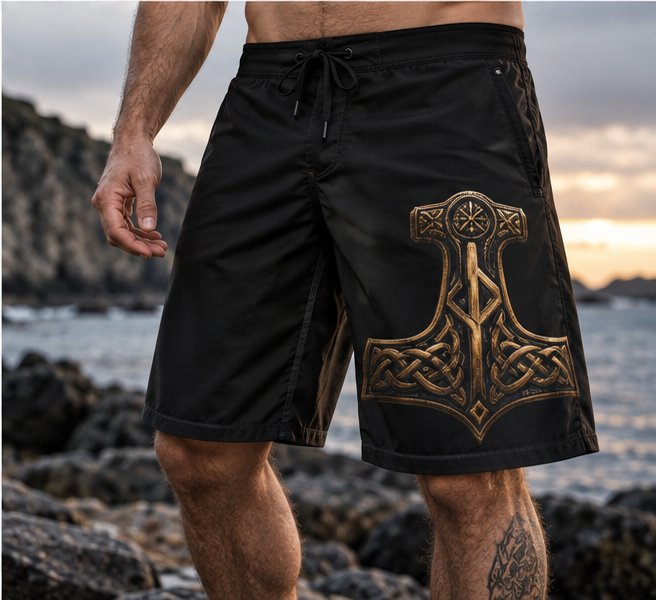
Runes Offer a More Personal Direction
Runes provide a different experience because individual characters can become much more personal.
Historically, runes were letters used within runic writing systems rather than a collection of modern motivational icons. That historical distinction matters. Modern symbolic interpretations should not automatically be presented as proven ancient meanings.
At the same time, people have continued interpreting and assigning significance to runes for generations.
That gives modern wearers an opportunity to approach them intelligently.
A person can learn the historical form, understand what is actually documented, recognize where later interpretation begins, and then decide whether the rune has personal significance.
This approach respects both history and personal meaning.
It also produces stronger apparel.
Instead of choosing a symbol simply because it looks mysterious, the wearer can know exactly which rune is on the garment and why they chose it.
That small amount of knowledge changes the relationship with the design.
One Symbol Often Carries More Meaning Than Many
Norse-inspired clothing can become visually crowded very quickly.
Runes, ravens, wolves, ships, hammers, trees, knotwork, shields, and geometric patterns can all be combined into a single image, but including more symbols does not automatically create a stronger design.
Often the opposite happens.
The central idea disappears.
One clearly presented rune can create more visual and personal impact than a field of unrelated characters. One strong Mjölnir can become the identity of a shirt. A well-designed Yggdrasil image can carry an entire composition without needing five other mythological references around it.
This restraint is particularly useful for men who want Norse-inspired clothing that works in normal everyday settings.
The garment can remain distinctive without feeling theatrical.
That makes it much easier to wear repeatedly.
Yggdrasil and the Idea of Connection
Yggdrasil offers a different type of symbolism from the hammer or individual runes.
The great tree connects the worlds of Norse mythology, which makes it naturally suited to modern interpretations involving connection, growth, continuity, and the relationship between different parts of life.
Those ideas can have particular relevance for someone balancing multiple responsibilities.
Work affects family. Health affects work. Personal discipline affects relationships. Financial decisions affect future freedom. Choices that appear isolated often send consequences into other areas.
A tree becomes an effective visual metaphor because no branch exists entirely by itself.
Roots, trunk, and branches belong to one system.
A modern wearer may therefore see Yggdrasil less as a fantasy object and more as a reminder that the life they are building is interconnected.
Growth in one area can strengthen another.
Neglect can spread too.
That is a practical interpretation for modern life without pretending that it is the only historical meaning of the symbol.
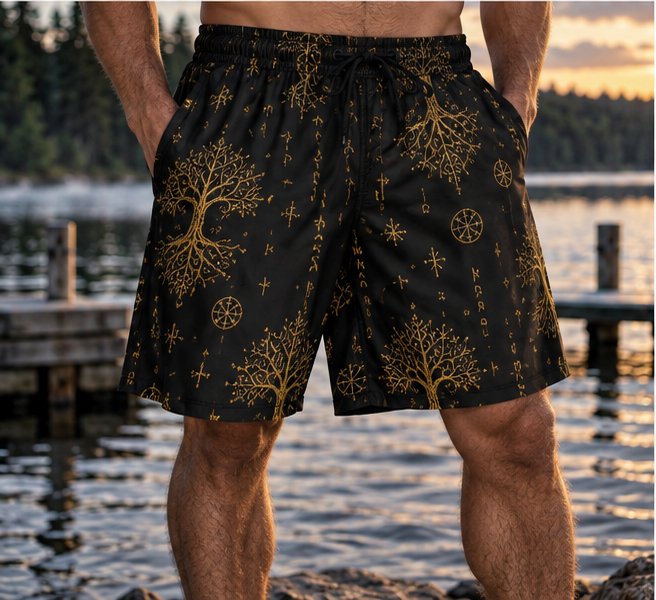
Knotwork Represents Continuity Through Design
Knotwork creates meaning differently.
Its visual impact comes from movement.
One line passes over and under another, continues forward, turns, and reconnects. The viewer can often follow the path through the entire pattern.
That makes knotwork naturally suited to ideas involving continuity, persistence, connection, and complexity.
It also works exceptionally well on modern clothing.
A wide knotwork band can run vertically down a shirt. It can travel along the sleeve of a hoodie or follow the outside of a leg. It can frame a rune without covering it.
The design becomes part of the garment rather than simply a rectangular graphic placed in the middle.
For Black Rune Works, wider and more readable knotwork also supports the overall visual direction better than extremely dense patterns.
The individual lines remain visible.
The garment feels detailed without becoming chaotic.
Why Black, Gold, Silver, and Bronze Work So Well
Color changes the emotional character of Norse-inspired imagery.
Gold against black has warmth and strong contrast. It can make a rune or knotwork design feel bold without requiring bright conventional colors.
Silver creates a colder and more restrained character. It works naturally with black apparel and can make detailed runic artwork feel sharper.
Bronze carries a weathered quality that suits Mjölnir and heavier knotwork particularly well. It creates the impression of aged metal while remaining a modern printed design.
These visual directions also make the garments easier to combine with an existing wardrobe.
Black jeans, denim, dark joggers, work pants, and ordinary footwear already work with these colors.
The symbolism can be distinctive while the outfit remains simple.
That balance is what turns themed imagery into lifestyle clothing.
Personal Meaning Develops Through Repetition
The meaning of a garment often changes after purchase.
A man may originally choose a rune shirt because he likes the design. Months later, that shirt may become connected to a period when he was building a business, dealing with an illness in the family, training toward a goal, or rebuilding after a difficult year.
The artwork did not create those experiences.
It was simply present during them.
That repetition can turn clothing into a personal object.
The same thing happens with an old work jacket, a favorite pair of boots, or a watch worn for years. Objects accumulate associations because they remain present while life happens.
Symbolic apparel begins with an additional layer because the artwork already represents an idea.
Personal experience builds on top of it.
That is how a garment can eventually mean far more to its owner than the original product description ever could.
Norse-Inspired Clothing Should Still Work as Clothing
Symbolism cannot rescue an uncomfortable or impractical garment.
Someone may connect deeply with a design, but if the shirt does not fit the way they like or the hoodie does not work with their normal wardrobe, it will probably spend most of its life in a closet.
This is why modern Norse apparel has to begin with the garment itself.
A T-shirt should work like a T-shirt.
A full-zip hoodie should layer easily.
Sherpa lining should provide additional warmth.
Leggings should allow movement.
Joggers should remain practical enough for everyday use.
The symbolism adds another layer rather than replacing basic function.
That principle keeps Black Rune Works firmly separated from costume clothing.
The products exist for modern life first.
You Do Not Have to Look Like a Viking
Norse-inspired apparel becomes much easier to wear once someone stops trying to build an entire Viking-themed outfit around it.
A rune shirt works with jeans.
A Mjölnir tee works with ordinary black pants.
A detailed Nordic hoodie can be paired with simple clothing already in the wardrobe.
Nothing else needs to prove where the inspiration came from.
There is usually no reason to add costume belts, fur, historical footwear, oversized jewelry, or multiple additional symbols unless that is genuinely the wearer's personal style.
A single strong piece often communicates more effectively.
The modern garment creates contrast with the older symbolism.
That combination is part of what makes it interesting.
Strength Can Be Quiet
Some of the strongest Norse-inspired designs are not the loudest ones.
A small chest emblem can carry meaning without announcing itself across the room. A silver rune on black can be visually powerful without bright color. Sleeve artwork can reveal itself gradually rather than dominating the entire garment.
This fits a broader interpretation of strength as well.
Real confidence does not always need maximum volume.
Discipline is often invisible. Responsibility usually happens without an audience. Persistence can consist of doing the same difficult thing repeatedly when nobody is watching.
Clothing based around those ideas does not need to shout.
A restrained design can sometimes communicate them more effectively than an oversized graphic.
Men Can Choose Symbols Based on What They Are Building
The most useful question is not necessarily what symbol describes someone today.
It may be what they are trying to strengthen.
A person who already feels strong may not need another reminder of strength. Someone learning patience might connect more with imagery they associate with restraint. Someone rebuilding after disruption may choose a design representing growth or continuity.
Symbolic clothing can point forward.
The wearer does not have to claim they already embody everything the artwork represents.
The symbol can instead represent a standard.
That makes it more useful as a daily reminder.
The garment becomes connected to direction rather than identity alone.
Historical Respect Makes Modern Designs Stronger
Modern Norse apparel does not have to be historically accurate clothing, but the symbols themselves deserve care.
Real runes should not be replaced casually with fictional characters and then marketed as ancient symbols.
Modern interpretations should be presented as interpretations rather than unquestionable historical fact.
That does not limit creativity.
It gives creativity better material.
A documented rune can still be rendered in gold, chrome, bronze, or silver. Knotwork can be completely original. A shirt can use asymmetric layouts that would never have existed historically. A hoodie can carry artwork across the back and sleeves.
The garment remains modern.
The historical foundation simply prevents the design from becoming empty fantasy disguised as authenticity.
Why Norse Symbols Fit Black Rune Works
Black Rune Works sits naturally between history and modern lifestyle apparel.
The brand does not need to recreate Viking Age clothing to respect Norse visual traditions. Instead, runes, Mjölnir, Yggdrasil, knotwork, and other imagery can be adapted into clothing designed for ordinary modern use.
That allows the same broader visual language to move across different garments while retaining its identity.
A bronze Mjölnir shirt can feel completely different from a silver rune hoodie. A black-and-gold Nordic pattern can create another direction. Women's apparel can carry the same design philosophy without simply copying men's products.
The collection does not need every item to look identical.
The connection comes from the approach.
Symbols should have a reason to exist.
Artwork should remain readable.
The garment should still be useful.
And the wearer should have room to decide what the design eventually means to them.
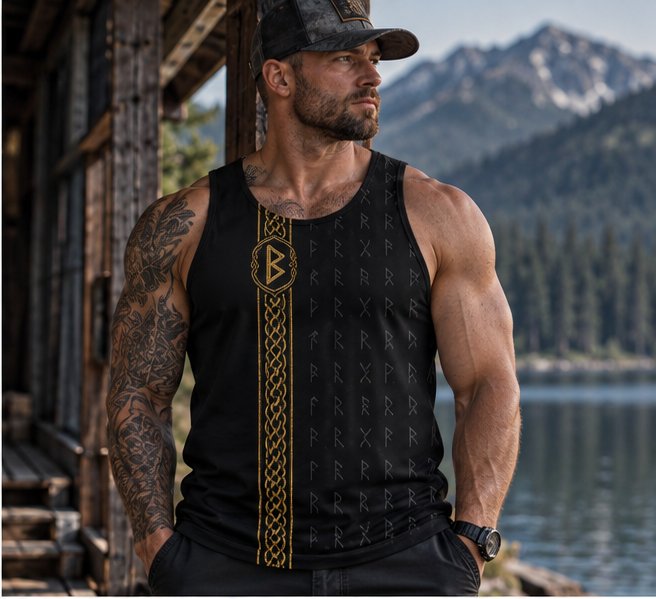
What a Norse Symbol Ultimately Becomes
History provides the starting point.
The designer gives the symbol a new visual setting.
The wearer gives it personal context.
That combination explains why ancient-looking imagery continues to work on completely modern clothing.
A rune does not stop being recognizable because it appears on a T-shirt.
Mjölnir does not lose its visual power because it is printed on a garment instead of cast in metal.
Yggdrasil can still suggest connection even when the person wearing it is navigating problems the original storytellers could never have imagined.
Symbols survive because people continue finding uses for them.
Modern Norse-inspired apparel is simply one of those uses.
The most meaningful pieces are not costumes pretending the modern world does not exist.
They are modern garments that allow older visual language to continue moving forward.
Frequently Asked Questions
Why do men wear Norse symbols today?
Men may connect with Norse symbols because of history, heritage, visual style, mythology, or personal ideas such as resilience, strength, discipline, growth, and responsibility. The reason varies from person to person.
Does wearing Mjölnir mean someone practices Norse religion?
Not necessarily. People wear Mjölnir for many reasons, including religious belief, cultural interest, historical interest, personal symbolism, or simply appreciation of the design.
Can runes have personal meaning?
Yes. Someone can learn the historical background of a rune while also developing a personal association with it. Personal interpretation should simply be distinguished from historically documented meaning.
Are all rune designs historically accurate?
No. Many modern designs use invented rune-like symbols. A shape can look runic without belonging to a documented historical runic alphabet.
Can Norse-inspired clothing be worn every day?
Yes. Modern T-shirts, hoodies, leggings, joggers, and similar garments can carry Nordic imagery while functioning like ordinary contemporary clothing.
Does Norse-inspired apparel have to be black?
No, although black provides strong contrast for silver, gold, bronze, and colorful artwork. Modern Norse designs can use many different palettes.
Is simple rune artwork better than complicated designs?
It depends on the garment and wearer, but a clear focal symbol with enough negative space often remains easier to recognize and easier to wear than an overcrowded composition.
Do you need Viking-style accessories with Norse clothing?
No. Norse-inspired shirts and hoodies can be worn with regular jeans, joggers, boots, sneakers, and other modern clothing.
Frequently Asked Questions
What defines a meaningful gift for a man who values minimalism and discipline?
A meaningful gift for a stoic man serves a purpose and reinforces his values. It avoids excess, noise, and frivolous decoration. Quality apparel that lasts years, wall art that reminds him of core principles, or handcrafted items that reflect craftsmanship align with stoic discipline. The gift should feel intentional, not impulsive, and add genuine value to his daily life or environment.
How do Norse-inspired symbols align with Stoic philosophy?
Norse philosophy and Stoicism both emphasize personal responsibility, acceptance of fate, and mastery over circumstance. Symbols like runes represent cosmic law and timeless wisdom. Norse-inspired gifts that carry these meanings serve as daily reminders of resilience and duty, making them particularly suited to men who practice stoic discipline and seek meaning beyond material comfort.
Why is utility a core component of stoic gift-giving?
Stoicism rejects excess and values what serves a function. A gift that is both beautiful and useful honors the recipient's values. Quality apparel worn regularly, wall art that inspires reflection, or items crafted with genuine care demonstrate respect for his time and priorities. Utility ensures the gift becomes part of his life, not a shelf ornament.