

Odin in Norse Mythology: Wisdom, Sacrifice, and the Search for Knowledge
Odin is one of the most recognizable figures in Norse mythology, but reducing him to a god of wisdom leaves out much of what makes him interesting. The surviving stories present a figure associated with knowledge, poetry, magic, war, death, kingship, runes, and an almost relentless search for understanding.
That search often comes with a price.
Odin does not simply possess wisdom because he is powerful. Again and again, the mythology connects knowledge with sacrifice, risk, discomfort, and uncertainty. That is one reason his stories still appeal to modern readers. They do not present wisdom as something effortless.
They present it as something pursued.
For modern Norse-inspired art and apparel, Odin also offers a richer foundation than the common image of a generic bearded warrior. Ravens, runes, the spear Gungnir, the story of Mímir’s well, and Odin’s association with knowledge all provide different ways to explore the figure without inventing new mythology around him.
Odin Was More Than a Warrior God
Odin is frequently associated with war, but describing him only as a warrior god misses most of his character.
He is connected with rulers and the dead, but also with poetry, magic, runes, knowledge, and prophecy. He appears as a wanderer, a seeker, a manipulator, a ruler, and a figure willing to cross boundaries in pursuit of information.
That complexity separates Odin from a simple heroic archetype.
He is not presented as someone who solves every problem through physical strength.
In many stories, knowledge matters more.
Understanding what is happening, discovering what has been hidden, and preparing for what may come are recurring parts of his mythology.
That makes Odin particularly interesting in a modern culture where strength is often portrayed as immediate action.
Sometimes the stronger position begins with knowing more.
Mímir’s Well and the Cost of Knowledge
One of the best-known stories associated with Odin involves Mímir’s well.
Odin seeks access to the wisdom connected with the well and gives up one of his eyes in exchange for a drink from it.
The story has become one of the clearest images connected with Odin because the trade is impossible to ignore.
Knowledge has a cost.
The mythology does not present Odin as receiving deeper understanding simply because he asks for it. He gives something up.
Modern readers naturally draw broader meaning from that story, but it is useful to keep the mythology and the interpretation separate.
Historically, the story belongs to the Norse mythological tradition.
Modernly, someone may see it as a reminder that meaningful knowledge often requires sacrifice.
Learning a trade requires time.
Building a business requires resources.
Mastering a skill involves repeated failure.
Changing an opinion may require admitting that an earlier belief was wrong.
Those are modern parallels, not ancient definitions of the myth, but the old story creates a powerful framework for thinking about them.
Odin’s Search for the Runes
Another major story places Odin at the center of the runic tradition.
In the poem Hávamál, Odin describes hanging on a windswept tree for nine nights, wounded by a spear and given no food or drink, before taking up the runes.
This is one of the most dramatic passages associated with him.
The runes are not treated as decorative symbols.
They are connected with knowledge that must be discovered.
That distinction matters for Black Rune Works because modern rune designs can easily lose touch with the fact that runes began as part of actual writing systems.
Their history is already interesting.
They do not need invented stories to make them meaningful.
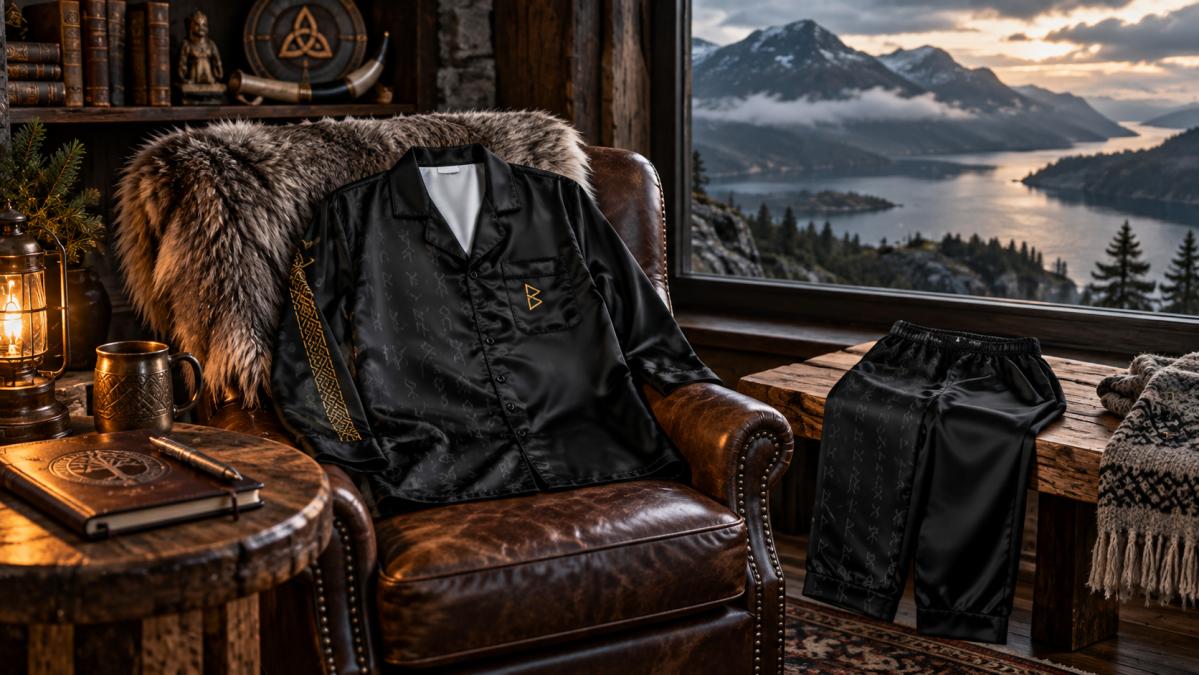
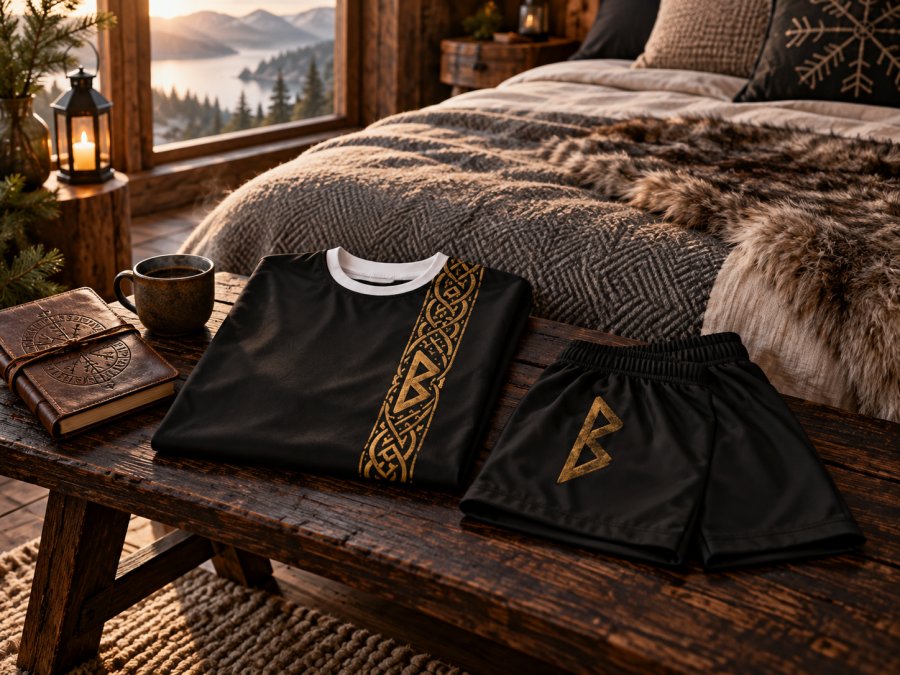
A modern designer may use a rune as artwork, combine it with knotwork, render it in gold or silver, or place it on completely contemporary clothing, but the historical form deserves to remain recognizable.
The modern treatment can change.
The foundation should stay real.
Odin’s Ravens: Huginn and Muninn
Odin’s two ravens, Huginn and Muninn, are among the most recognizable animals in Norse mythology.
Their names are commonly associated with thought and memory.
The ravens travel and return with information, creating an image of Odin as a figure who depends on observation and knowledge from beyond his immediate surroundings.
That symbolism has naturally expanded in modern culture.
Ravens are frequently used to represent awareness, intelligence, memory, experience, and the importance of seeing beyond what is directly in front of us.
Those meanings work particularly well in modern artwork because the raven already has a powerful visual character.
A design does not need to turn the bird into a fantasy creature.
The raven itself carries enough presence.
For Norse-inspired apparel, this allows a design to feel connected with Odin without needing to show Odin himself.
Thought and Memory Work Together
The pairing of Huginn and Muninn creates another interesting modern interpretation.
Thought without memory has little foundation.
Memory without thought becomes little more than stored experience.
Together, they suggest the importance of considering what has happened before deciding what happens next.
That idea is particularly relevant to personal growth, work, and decision-making, but it should be understood as a modern reflection rather than a direct Viking Age teaching.
The mythology provides the image.
Modern readers provide the application.
That distinction makes the symbolism more honest while leaving plenty of room for personal meaning.
A raven design can therefore mean something different to different people.
One person may connect it with wisdom.
Another may associate it with remembering where they came from.
Someone else may simply appreciate the connection with Odin and Norse mythology.
The symbol does not need a single universal modern meaning.
Odin and the Pursuit of Knowledge
Odin’s mythology repeatedly returns to the pursuit of information.
He seeks knowledge about the future.
He seeks the runes.
He seeks wisdom from Mímir.
He seeks poetry and magical knowledge.
That pattern gives him a very different personality from a god who simply rules from a distance.
He is constantly searching.
There is also something uncomfortable about that search.
Odin’s desire for knowledge is not always portrayed as gentle or morally simple. His stories can involve deception, manipulation, sacrifice, and difficult choices.
That complexity matters.
Turning Odin into a modern motivational figure can flatten the mythology.
He is more interesting when the difficult parts remain.
Wisdom does not automatically make someone good.
Knowledge provides capability.
What someone does with that capability remains another question entirely.
Wisdom Is Not the Same as Certainty
One useful modern lesson from Odin’s stories is that seeking knowledge does not eliminate uncertainty.
In Norse mythology, even knowing more about fate does not mean everything can be avoided.
This creates a much more realistic relationship with knowledge.
Understanding a problem does not always mean you can control it.
Knowing the risks of a decision does not guarantee a perfect outcome.
Learning from experience does not remove future uncertainty.
Wisdom may simply mean making a better decision while knowing that uncertainty still exists.
That is very different from the popular idea that wisdom provides a complete answer.
Often it provides a clearer question.
Odin and Wyrd Are Not the Same Thing
Modern Norse discussions often mix Odin with ideas surrounding fate, destiny, and wyrd.
These concepts are related within the broader Germanic and Norse world, but they should not be collapsed into one simple philosophy.
Wyrd is an Old English term with its own history, while Norse mythology includes concepts of fate involving the Norns and other traditions.
Modern writers frequently combine these ideas into a general concept of fate being shaped by actions.
That can be a useful modern philosophy, but it should not automatically be presented as one fixed ancient doctrine.
Black Rune Works can still explore these themes.
The stronger approach is simply being clear about where the mythology ends and modern interpretation begins.
Historical accuracy does not make symbolism less useful.
It keeps it grounded.
Odin’s Spear Gungnir
Gungnir, Odin’s spear, is another important symbol associated with him.
The spear fits naturally with Odin’s connection to war and authority, but it also gives designers a different visual direction from the more commonly used Mjölnir.
A spear creates a long vertical composition.
That can work especially well in apparel design because it can follow the shape of a sleeve, back panel, or narrow graphic area.
It also allows Odin-inspired artwork to remain recognizable without relying on a portrait of the god.
The strongest symbolic designs often work this way.
They suggest the larger mythology through one recognizable element.
The design does not need to show everything at once.
Odin-Inspired Design Does Not Need to Become Dark Fantasy
Odin is frequently portrayed in modern media as a grim armored warrior surrounded by lightning, ravens, skulls, and glowing symbols.
That can produce dramatic artwork, but it is not the only direction available.
A more restrained design can be stronger.
Two ravens may be enough.
A spear and a rune composition may be enough.
A single eye motif combined with knotwork may communicate the connection without overwhelming the garment.
The more recognizable the symbol, the less additional decoration it usually needs.
This is especially important in clothing.
Artwork has to survive fabric movement, printing, distance, and normal wear.
A clear design usually remains stronger than one packed with tiny details.
Real Runes Matter More Than Rune-Like Decoration
Odin’s connection with runes makes historical accuracy particularly important.
Modern Nordic artwork often uses angular symbols that look like runes without belonging to a historical rune row.
That may create the right visual mood, but it should not be presented as genuine runic writing.
Real runes already provide plenty of design possibilities.
Their simple geometry works naturally with modern apparel.
They can be repeated as subtle background texture.
One rune can become the central focal point.
A vertical rune sequence can work on a sleeve or pant leg.
The designs can be weathered, metallic, tonal, or brightly colored.
There is no shortage of creative freedom.
The symbol itself does not have to be invented.

Modern Meaning Can Exist Without Rewriting History
Someone does not need to practice Norse religion to find meaning in Odin’s stories.
A person may connect with the pursuit of knowledge.
Another may be drawn to the ravens.
Someone else may see the sacrifice at Mímir’s well as a reminder of the price required to achieve something important.
These are modern relationships with old stories.
They are still legitimate.
The important thing is not claiming that every modern interpretation was an established Viking Age belief.
Symbols survive partly because different generations continue finding new meaning in them.
History provides the starting point.
The modern wearer or reader provides another layer.
Why Odin Still Works for Black Rune Works
Odin fits naturally into Black Rune Works because his mythology connects directly with several elements already central to Norse-inspired design.
Runes provide one direction.
Ravens provide another.
Gungnir creates a strong weapon-based image without repeating Mjölnir.
The eye and Mímir story introduce symbolism connected with knowledge and sacrifice.
Knotwork can support those elements without replacing them.
This gives the brand room to create Odin-inspired designs without making every piece look the same.
The important part is keeping the mythology recognizable.
A design can be completely modern while still respecting the source that inspired it.
That is the balance Black Rune Works should continue building around.
Frequently Asked Questions
What is Odin the god of in Norse mythology?
Odin is associated with many areas, including wisdom, poetry, magic, war, death, kingship, runes, and knowledge. Reducing him to only one role leaves out much of the complexity found in the surviving mythology.
Why did Odin sacrifice his eye?
In the story associated with Mímir’s well, Odin gives one of his eyes in exchange for a drink connected with wisdom and knowledge. The story has become one of the most recognizable examples of Odin’s willingness to sacrifice something valuable in pursuit of understanding.
How did Odin discover the runes?
In Hávamál, Odin describes hanging on a tree for nine nights, wounded by a spear and without food or drink, before taking up the runes. The passage connects runic knowledge with sacrifice and discovery.
What are the names of Odin’s ravens?
Odin’s ravens are Huginn and Muninn. Their names are commonly connected with thought and memory, and they are described as traveling through the world before returning to Odin.
What does Odin’s raven symbolism mean today?
Modern interpretations often connect Odin’s ravens with knowledge, awareness, observation, thought, memory, and learning from experience. These contemporary meanings build on the mythological connection but should not automatically be presented as fixed ancient definitions.
What weapon is associated with Odin?
Odin is associated with the spear Gungnir. It is one of the major objects connected with him and provides a recognizable alternative to the hammer imagery associated with Thor.
Is Odin only associated with war?
No. War is one part of Odin’s mythology, but he is also deeply connected with knowledge, magic, poetry, runes, death, and prophecy.
Can Odin symbols be used on modern clothing without pretending they are historical garments?
Yes. Modern apparel can use ravens, runes, Gungnir, knotwork, and other Odin-inspired imagery while remaining clearly contemporary clothing. Historical inspiration and historical reproduction are different things.
Frequently Asked Questions
How does Norse mythology apply to modern leadership styles?
Norse mythology offers a framework for decision-making under pressure. Odin's pursuit of knowledge shows that good judgment requires investment, sometimes at personal cost. Modern leaders can apply this by accepting short-term losses for long-term gains, listening before acting, and treating wisdom as a discipline rather than a trait. The myths do not offer easy answers, but they model the patience and resolve that leadership demands.
What does it mean to lead with honor and resilience?
Leading with honor means your word holds even when no one is watching. Resilience means you absorb setbacks without passing the cost to your team. Together, they form a standard: you take responsibility for outcomes, you do not cut corners when pressure rises, and you show up consistently. This is not about perfection. It is about being the person others can rely on when conditions turn difficult.
How can I practice self-mastery in a professional environment?
Start with one daily ritual that tests your discipline. It could be reviewing your priorities before opening email, or pausing before reacting to a frustrating message. Odin's stories emphasize preparation and restraint, not impulse. Choose a small practice, keep it consistent, and let it shape how you respond under stress. Self-mastery grows through repetition, not grand gestures.
Leadership is not a title; it is a series of costly choices made in the right order. Study first, decide with the price in mind, and hold the line on discipline and honor when it would be easier not to. Explore the Black Rune Works Odin's Rules collection to keep those principles where you will see them every day.