

Norse Symbols and Their Meanings: Choosing One That Fits You
Norse symbols are easy to recognize, but choosing one because it looks powerful is very different from choosing one because you understand what it represents.
Runes, Mjölnir, Yggdrasil, ravens, knotwork, and other Nordic-inspired imagery have become common across modern clothing, jewelry, tattoos, and artwork. Some have strong historical foundations. Others have collected layers of interpretation over hundreds of years. Still others are modern creations that simply borrow the visual language of Norse culture.
That distinction matters.
A symbol becomes more meaningful when the person wearing it knows where it came from, what can actually be supported historically, and which meanings belong to later or modern interpretation.
Black Rune Works approaches Norse-inspired apparel from that perspective. The clothing is modern, but the symbolism deserves more care than simply calling every angular design a Viking rune.
The right symbol does not have to tell everyone else who you are.
It can simply remind you what matters.
Start With What Actually Connects With You
Choosing a Norse symbol does not have to begin with mythology.
It can begin with a question.
What are you trying to strengthen in your life?
Someone rebuilding after a difficult period may connect with imagery associated with renewal and growth. Another person may be focused on discipline, protection, responsibility, or endurance. Someone else may simply have a deep interest in Norse history and want to wear a symbol because they appreciate its origin.
There is no requirement that everyone choose symbols for the same reason.
The important part is understanding that personal meaning and historical meaning are not always identical.
A modern wearer may connect Berkano with growth, for example, while recognizing that this is a contemporary symbolic interpretation built around the rune's historical name and association with birch.
That does not make the personal meaning false.
It simply means it belongs to the wearer rather than being presented as an unquestionable ancient belief.
That honesty gives the symbol more substance.
Runes Were Letters Before They Became Modern Symbols
One of the most important things to understand about runes is that they were part of writing systems.
They were not originally created as a catalog of motivational icons.
The Elder Futhark contained twenty-four characters and was used long before the Viking Age. Later runic alphabets developed as Germanic languages changed.
Each rune had a sound value, and rune names provided additional linguistic connections that later generations often used when developing symbolic interpretations.
That history is one reason real runes are more interesting than invented rune-like graphics.
A genuine rune already has a story.
There is no need to fabricate one.
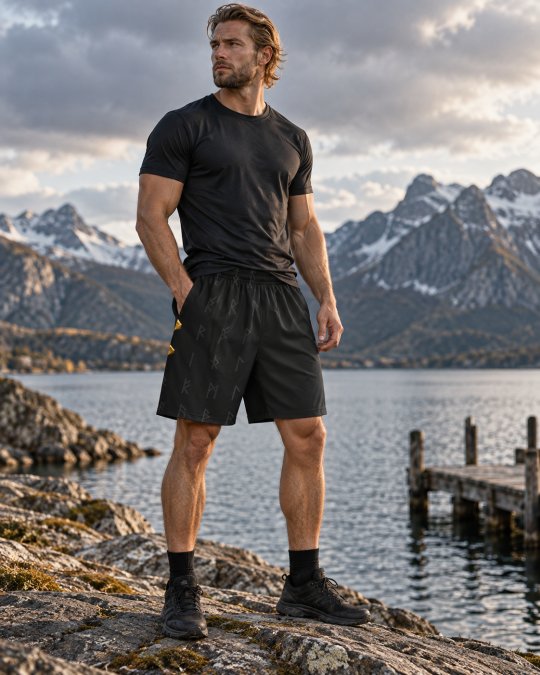
Modern design can still do almost anything around it. A rune can be rendered in silver, gold, bronze, teal, or black. It can be framed by knotwork, placed on a hoodie sleeve, worked into leggings, or used as a large central design.
The creative treatment is modern.
The rune itself remains recognizable.
Berkano Can Represent Growth and Renewal
Berkano is one of the Elder Futhark runes and is commonly connected linguistically with the birch tree.
That historical association has contributed to modern interpretations involving growth, renewal, beginnings, development, and regeneration.
Birch provides a strong natural image for those ideas.
New growth often begins quietly.
A person rebuilding a business, recovering from a difficult period, changing direction, or starting a new chapter may not feel powerful while the process is happening.
Progress can look small.
That is why Berkano works particularly well as a modern symbol of rebuilding.
It does not need to promise instant transformation.
Its value can come from reminding the wearer that growth requires time, consistency, and the willingness to begin again.
Mjölnir Carries a Different Kind of Strength
Thor's hammer, Mjölnir, is one of the most recognizable symbols connected with Norse mythology.
Its visual strength makes it naturally suited to modern apparel, but the hammer becomes more interesting when strength is understood as something broader than physical power.
Strength without direction can become destructive.
A modern wearer may therefore interpret Mjölnir through ideas such as responsibility, protection, courage, stability, or the willingness to stand behind a commitment.
The hammer itself does not make someone strong.
It can represent a standard.
That distinction matters because symbolic clothing works best when the image points back toward behavior.
Wearing a symbol of strength means very little if the wearer never practices restraint, responsibility, or persistence.
The symbol provides the reminder.
The person does the work.
Yggdrasil Can Represent Connection and Growth
Yggdrasil occupies a central place in Norse mythology as the great tree connected with the different worlds of the Norse cosmos.
Modern interpretations frequently connect it with growth, connection, continuity, balance, and the relationship between different parts of life.
That symbolism feels especially relevant now.
Work affects family.
Health affects work.
Relationships affect emotional stability.
Financial decisions affect future freedom.
One part of life rarely remains completely isolated from another.
A tree becomes a useful visual metaphor because roots, trunk, and branches depend on the same living system.
Someone may wear Yggdrasil as a reminder that building a strong life means paying attention to the whole structure rather than one branch.
Growth in one area can support another.
Neglect can spread too.
Ravens Carry Ideas of Thought and Memory
Ravens are another powerful part of Norse imagery, particularly through Odin's ravens Huginn and Muninn.
Their names are generally connected with concepts of thought and memory.
That gives ravens a very different character from the hammer.
Instead of emphasizing force or protection, raven imagery can suggest awareness, observation, knowledge, reflection, and the importance of remembering experience.
For someone who values learning from mistakes rather than simply surviving them, that symbolism can become particularly meaningful.
The past becomes useful when it informs the next decision.
Memory without reflection can become nostalgia.
Thought without action can become hesitation.
The two ravens together provide a compelling visual reminder that awareness and experience work best when they remain connected.
Knotwork Does Not Need a Single Fixed Meaning
Knotwork is different from an individual rune or mythological object because much of its meaning comes through visual structure.
Lines weave over and under one another.
Paths continue.
Sections connect.
The design may appear complicated at first, but its strength often comes from continuity.
That makes knotwork naturally compatible with modern ideas involving persistence, connection, endurance, and the way different parts of life become intertwined.
Those meanings should not automatically be presented as ancient historical definitions.
Modern interpretation is perfectly capable of standing on its own.
The visual design itself creates the association.
This is also one reason knotwork works so well on clothing.
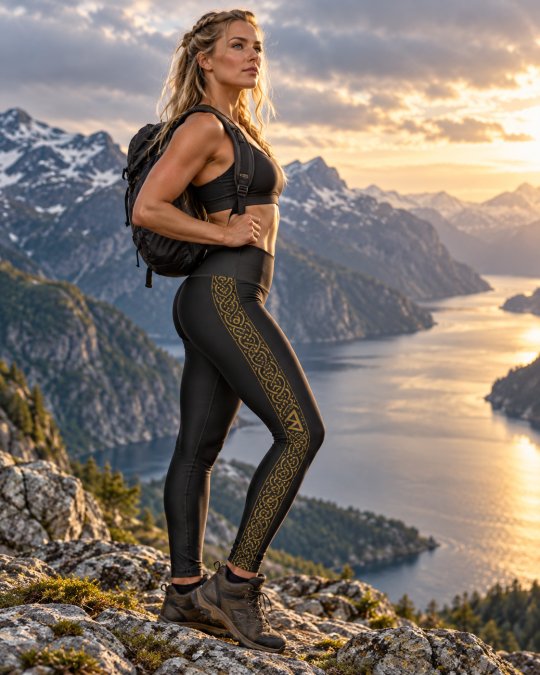
A wide band can travel down the side of leggings, across a shirt, or along a sleeve. The garment provides movement, and the pattern follows that movement.
The symbolism becomes part of the structure instead of simply being printed in the middle.
One Symbol Often Works Better Than Many
There is always a temptation to add more.
One rune becomes five. A hammer gains ravens. Ravens gain wolves. Knotwork fills the background. Additional symbols are placed anywhere empty fabric remains.
Eventually the garment stops communicating anything clearly.
A single strong symbol often creates more impact.
If the wearer connects with Mjölnir, the hammer can remain the focus.
If Berkano represents a personal period of rebuilding, there may be no reason to surround it with unrelated runes.
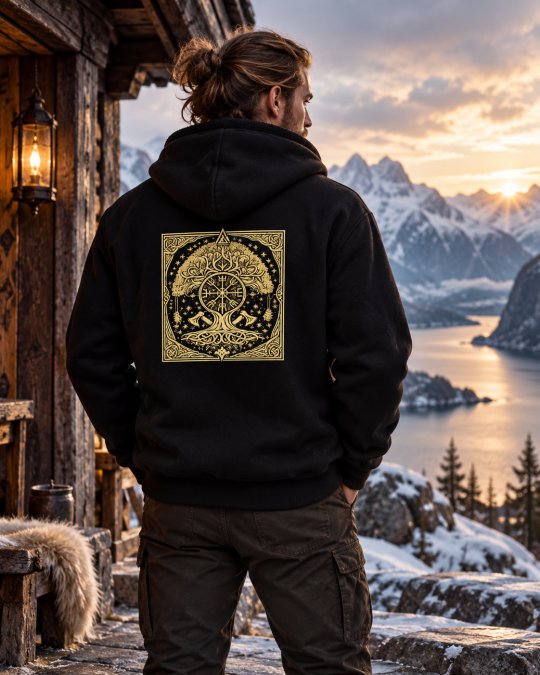
If Yggdrasil is the central idea, the tree can carry the composition.
Supporting artwork can still exist, but it should reinforce the main idea rather than compete with it.
This is as much a styling principle as a design principle.
Clarity makes symbolism easier to understand.
Modern Color Does Not Change the Historical Symbol
A historical rune does not stop being a historical rune because it is rendered in gold.
Mjölnir does not become less recognizable because the artwork uses bronze.
Yggdrasil can be presented in silver, cream, gold, black, or another modern palette.
Color is part of contemporary design.
It affects mood.
Gold against black feels warm and bold.
Silver creates a colder and more restrained appearance.
Bronze can suggest aged metal.
Cream and gold can make the same Nordic design language feel lighter.
Modern teal or cyan can move the artwork even further from historical reproduction while keeping the original symbol recognizable.
That freedom is important.
Black Rune Works is not reproducing archaeological garments.
It is building modern apparel around older visual influences.
Meaning Does Not Require Supernatural Claims
Norse symbolism does not need exaggerated promises to become meaningful.
A rune does not have to magically attract wealth.
A hammer does not create an invisible shield.
A tree symbol does not guarantee growth.
The object can still matter.
People use physical reminders constantly.
A wedding ring carries meaning because of what it represents.
A photograph can immediately bring back a memory.
An old jacket may become connected with a particular period of life.
Symbolic clothing works in a similar way.
A garment can become associated with a commitment, transition, goal, or personal principle.
The power is not hidden inside the fabric.
It comes from the relationship between the person and what the symbol represents.
That is more grounded, and often more meaningful, than treating every Norse image as a supernatural tool.
Choose a Symbol You Will Still Want to Wear
Meaning matters, but so does the garment.
Someone may connect strongly with a rune and still dislike an enormous graphic covering an entire shirt.
Another person may love large artwork and find small symbols too restrained.
Neither approach is wrong.
Symbolic clothing still has to fit the person wearing it.
A subtle tonal rune pattern may work better for someone who normally dresses simply.
A large bronze Mjölnir may suit someone who prefers bolder artwork.
Vertical knotwork may feel natural on athletic apparel.
A large Yggdrasil design may work better across the back of a hoodie.
The symbol should enter the wearer's existing style rather than forcing that person to become someone else.
That makes it far more likely that the garment will actually be worn.
The Meaning Can Change Over Time
One of the most interesting things about symbolic apparel is that the original meaning is only the beginning.
A person may buy a rune shirt because they like the artwork.
Years later, that same garment may be connected with an important period in their life.
A hoodie may become associated with rebuilding after a difficult winter.
A pair of leggings may remind someone of months spent working toward a physical goal.
A Mjölnir shirt might become connected with a period when the wearer had to carry more responsibility than expected.
Objects collect memories.
That personal history eventually becomes part of the symbol.
The wearer may understand the historical background while also carrying an entirely individual meaning that nobody else could see.
That is where symbolic clothing becomes genuinely personal.
You Do Not Need to Explain Your Symbol to Everyone
A symbol does not need public approval.
Someone may ask what it means.
You can explain it if you want.
But clothing does not have to function as a public statement every time it is worn.
Sometimes the wearer is the only person who needs to understand the meaning.
That privacy can make symbolism stronger.
A small rune may remind the wearer of a promise they made to themselves.
A Yggdrasil design may represent a family connection that is not obvious to anyone else.
A Mjölnir graphic may be tied to a difficult period that the wearer survived.
Other people see the artwork.
The wearer sees the history behind it.
Both experiences can exist at the same time.
Why Choosing Real Symbols Matters to Black Rune Works
Black Rune Works is moving further toward rune-centered and Nordic-pattern apparel, which makes the foundation of the artwork increasingly important.
A design does not need fake runes to look Nordic.
Real runes already provide a deep visual language.
Mjölnir already has centuries of mythology behind it.
Yggdrasil does not require invented lore.
Knotwork does not need false historical claims to become visually powerful.
Beginning with real symbols gives the modern artwork more freedom because the foundation is already strong.
The metallic finish can be modern.
The garment can be modern.
The composition can be original.
The person wearing it can assign personal meaning.
None of those things require pretending that a contemporary design was found carved on a Viking Age stone.
Modern creativity and historical respect can exist together.
The Right Symbol Is the One You Understand
There is no universal Norse symbol that every person should choose.
The strongest choice is usually the one that continues to feel relevant after the initial visual attraction wears off.
Learn where the symbol comes from.
Understand what history can actually support.
Recognize which interpretations are modern.
Then decide what the symbol means to you.
That process turns a graphic into something more personal.
The rune, hammer, tree, raven, or knotwork existed before the garment.
Modern design gives it a new setting.
The wearer gives it another story.
That is how old symbols continue moving forward.
Frequently Asked Questions
What are the most recognizable Norse symbols used in modern clothing?
Runes, Mjölnir, Yggdrasil, ravens, and Nordic knotwork are among the most recognizable elements used in contemporary Norse-inspired apparel. Each comes from a different historical or mythological context, so their meanings should not automatically be treated as interchangeable.
Are all symbols marketed as Viking runes historically real?
No. Many modern graphics are invented to resemble runes without belonging to a documented runic alphabet. When historical accuracy matters, the symbol should be checked against an actual rune row such as the Elder Futhark or Younger Futhark.
Can I give a rune my own personal meaning?
Yes. A rune can have a historical identity while also carrying a modern personal association. The important distinction is not presenting a personal interpretation as though it were a proven ancient definition.
What does Mjölnir symbolize today?
Modern wearers frequently connect Mjölnir with ideas such as strength, protection, responsibility, courage, and resilience. The exact personal meaning varies by wearer.
What does Yggdrasil represent?
Yggdrasil is the great tree associated with the interconnected worlds of Norse mythology. Modern symbolism often connects it with growth, connection, continuity, balance, and the relationship between different parts of life.
What do Odin's ravens represent?
Huginn and Muninn are commonly associated through their names with thought and memory. Modern interpretations often expand that symbolism into awareness, observation, knowledge, and learning from experience.
Do I need to follow Norse religion to wear Norse symbols?
No. People may wear Norse imagery because of religion, history, heritage, mythology, artistic interest, or personal symbolism. The meaning depends on the individual.
How should I choose a Norse symbol for clothing?
Choose a symbol whose history and modern interpretation genuinely interest you, then select a design you will actually want to wear. Understanding the symbol generally creates a stronger connection than choosing something only because it looks powerful.
Frequently Asked Questions
What defines the shieldmaiden archetype in a modern context?
The shieldmaiden archetype represents disciplined strength, not fantasy combat. In modern life, it shows up as a woman who sets boundaries, keeps her word, and protects what matters: her family, her work, her integrity. It is about internal fortitude and self-mastery rather than physical battle. Norse-inspired brands like Black Rune Works often reference this archetype through collections such as Freyja, which emphasize courage, independence, and personal responsibility.
How can Norse-inspired values improve personal accountability?
Norse-inspired values emphasize honor, which means doing what you said you would do, even when no one is watching. Practicing daily self-mastery, such as keeping a simple promise to yourself each morning, builds an internal locus of control. Over time, this habit strengthens your ability to follow through on commitments. Many people find that wearing or displaying meaningful symbols serves as a daily reminder of these principles.
What role does self-mastery play in the life of an independent woman?
Self-mastery is the foundation of independence. It means managing your emotions, your time, and your reactions without relying on others to regulate you. For independent women, this looks like setting a morning routine, pausing before reacting in stressful moments, and choosing long-term goals over short-term comfort. Norse-inspired values frame this as a form of inner strength that grows with practice, not a fixed trait you are born with.